


Death Came from the Sky, and No One Is Claiming Responsibility
29 de septiembre de 2026Two cocaine labs went up in flames 48 hours apart in southwestern Colombia last January, in mysterious incidents that killed at least 17 civilians. After suspicions were raised about Ecuador and the United States, eight months later no one has claimed responsibility, and the Attorney General’s Office remains silent about its investigation.
By Sibylla Brodzinsky
Night had already fallen when Wilmer*, 43, finished his day’s tasks at the clandestine cocaine lab where he worked in a rural area of Llorente, in Nariño department. He stepped out from under the black plastic tarp covering the processing area of the cocaine-production complex, taking care not to let any light escape. About 18 of his co-workers remained inside.
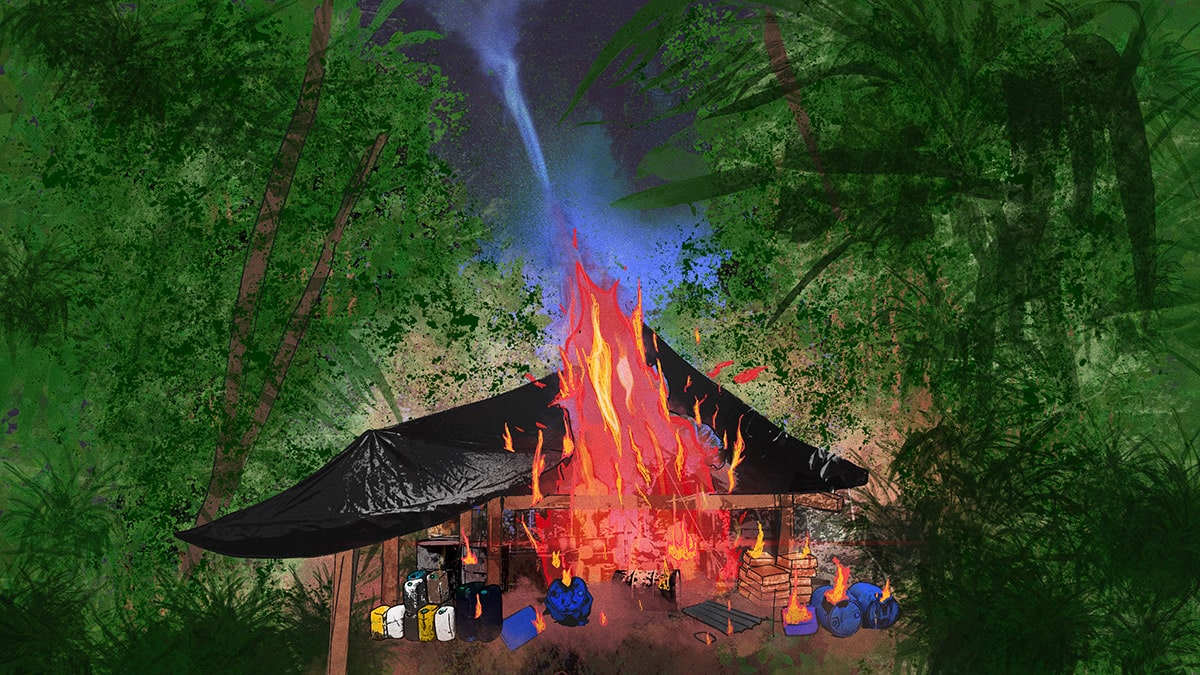
Wilmer lay down in a hammock to rest when he saw a red light in the sky. It was unsettling. For days, the lab workers had been seeing drones circling in the darkness at night. But that night, January 22, 2026, was different. At around 7:40 p.m., the light Wilmer had seen came down onto the tarp, starting a devastating fire that instantly burned at least eight civilians to death, though the final toll would be higher.
The incident, in a small community of Tumaco Nariño called Inda Sabaleta near the town of Llorente, 23 kilometers from the nearest point of the border with Ecuador, aroused suspicions among local residents and regional authorities. And when, two days later, in the early hours of January 24, an almost identical explosion occurred at another lab in the far north of Tumaco, killing at least five civilians, alarm bells went off all the way to the presidential palace.
Then-president Gustavo Petro publicly suggested, based on what he called “popular intelligence,” that the mysterious explosions may have been attacks launched from Ecuador, possibly even with assistance from the United States. However, no evidence was ever presented publicly, and the Ecuadorian government denied carrying out operations on Colombian territory.
Although investigations were opened and forensic examinations conducted, nearly eight months after the incidents there is still no clarity about where the attacks may have come from. Oswaldo Andrés Ocampo, the Tumaco prosecutor who took charge of the investigation, responded to a request for information by saying that because the inquiry remains at the preliminary stage, “it is not possible to provide detailed information about the investigation.”
But new evidence revealed by The New York Times and The Washington Post that U.S. private contractors or even the CIA may have carried out covert operations around the same time against Ecuadorian fishing boats suggests that these incidents may have been part of the same clandestine operation.
Through multiple interviews with witnesses, survivors, and victims’ relatives, as well as visits to the sites and official information, VerdadAbierta.com was able to reconstruct what happened at the two locations. The effort is part of a collaborative investigation with partner news organizations coordinated by the Latin American Center for Investigative Journalism (CLIP), which has been tracking the bombings—part of the Washington-led strategy against drug trafficking—that have left multiple civilians dead.
Inda Sabaleta
When he felt the first explosion, Wilmer ran toward the processing area to try to rescue his co-workers who had been trapped inside. He found one of them, whom everyone knew as Mario, lying on the ground. The black plastic tarp was melting in the heat of the flames, but with the help of other workers they managed to carry Mario out alive on a blanket. “He was bleeding from his nose and mouth,” says Wilmer, who asked that his name be withheld for fear of reprisals. “The explosion tore him apart inside.”
Mario, whose given name was Andrés David Martínez, was 29. He was treated at San Andrés Hospital in Tumaco and was transferred to Pasto, where he died five days later. Most of the victims, though, died instantly at the site when the flames reached a drum filled with acetate used in cocaine processing, known as “el marrano” (“the pig”), causing a large explosion. Those nearby “were left looking like fried pork rinds,” Wilmer says.
One of them was Jaider Romero Grueso, 28, whom family and friends called Matías. He was one of the 12 people officially recorded as having died in the explosion. Born in Peña de los Santos on the Rosario River, near Inda Sabaleta, the young man was a well-known party decorator in Tumaco who in 2024 won the Miss Pacífico Transformista contest, an annual drag queen pageant in the region. But those activities did not bring in enough money to support his family, according to his mother, Milena Valencia, so from time to time he would go to Llorente to work in the labs. “Whenever they called him to go earn a little money, he would head up there,” she says. He had been working in Inda Sabaleta for three days when he died in the explosion.
Pital de la Costa
News of the mysterious fire spread across social media under the hashtag #LlorenteEstadeLuto (#LlorenteIsInMourning), along with photographs of the victims and messages of grief and condolence. Those posts put workers at another lab 100 kilometers away on alert.
There was a sense of unease throughout the night shift on January 23 among the dozens of people working at the “chongo,” as the labs are known there, near the community of Pital de la Costa.
At around 4 a.m. on January 24, Yeferson* finished his shift and went to shower in the sleeping quarters of the complex, 15 meters from what they call “the strip.” From the open-air shower, he saw what he described as a bluish light falling onto the black plastic tarp.
“There was a light coming down. Right away I said, ‘They’ve set us on fire,’” Yeferson recalls. He ran toward the forest and heard the explosion. “As soon as it came down, it exploded.”
It did not descend in a steady line, he says, but in bursts, “like a flare,” resembling the flame of a gas stove. He insists that what he saw could not have been a reflection from anything outside because the lab was sealed along the sides and across the roof with black plastic.
Another witness said the falling object glowed with a “bluish tint, somewhere between blue and white.” In the total darkness, all that could be seen was the light descending directly toward the roof tarp. Yeferson managed to shout for everyone to run before the blast.
In the explosion at the Pital de la Costa chongo, brothers Andrés and Edin Poniel Coime Angulo and César Antonio González, known as “Cholopín,” were burned to death instantly. Their torsos were twisted and charred, as VerdadAbierta.com was able to confirm from photographs of the dead, which we are not publishing because of their graphic nature.
Members of the community who arrived to try to put out the fire had to wait several hours for the flames to subside before they could approach the bodies. “We got there and we just poured water on it, poured water on it, trying to put it out. Everything was burning,” recalls Gerson Angulo, who took part in the recovery effort.
They found the remains of the Coime Angulo brothers and “Cholopín” together. “One here, another there, another over there,” Gerson says, pointing to where they had been. They identified them by the shape of their remains: “The big one was Andrés; he was the most heavily built.” Then they found Poniel’s charred remains, followed by Cholopín’s, all three bodies contracted by the intense heat. One was missing his skull.
The remains were taken by canoe to the village, where people waited anxiously, and were later buried by their families, sealing their fate as victims invisible in the official figures. When an investigative team from the Attorney General’s Office arrived a few days later, it did not question members of the community. “The Attorney General’s CTI investigators came, but they didn’t speak to us at all about what happened. They didn’t come to ask us any questions,” says Guillermo Granja, the father of the Coime Angulo brothers. The Attorney General’s Office did not respond to questions about why the bodies, which had already been buried, were not formally recovered and examined.


María Luisa Segura, a cousin of Carlos Arturo Segura, who was known as “Popeye” or “La Poupé,” accompanied those injured in the Pital explosion on the nearly two-hour boat journey to the port of Tumaco, where the nearest hospital is located. They drank an electrolyte beverage while sheltering beneath blankets to protect their burns from the sun.

At San Andrés Hospital in Tumaco, doctors determined that Carlos Arturo had infected burns covering nearly half his body. After debridement surgery to remove dead tissue, he was transferred to the University Hospital in Pasto because the Tumaco hospital does not have a burn unit. “Popeye,” the sole financial support for his 80-year-old grandmother, died from his injuries on January 28 in Pasto, the capital of Nariño department. José Manuel Caicedo died on February 1.
“It had never happened before”
As part of its fight against drug trafficking, Colombia’s security forces target sites where coca leaves are processed into coca paste, as well as more sophisticated laboratories where that paste is turned into cocaine. Between 2022 and 2025, the security forces said they had destroyed 17,838 processing sites, according to Defense Ministry data. In 2025 alone, 203 cocaine hydrochloride laboratories, facilities like those in Pital de la Costa and Inda Sabaleta, were destroyed.
However, the incidents in Tumaco on January 22 and 24 bear little resemblance to the methods normally used by Colombia’s military and police against such facilities.
“These were two unprecedented fires,” Luis Alfonso Escobar, governor of Nariño department, said in an interview at his offices in Pasto. “It had never happened before.”
For the communities of Pital de la Costa and Inda Sabaleta, it is clear that neither fire originated inside the laboratories, as was initially speculated.
Any electrical discharge poses a danger in cocaine laboratories because they use highly flammable chemicals such as acetone and gasoline to turn coca paste into the white powder consumed by an estimated 25 million people around the world. That is why workers know they cannot enter the chongos carrying anything metallic. Wilmer, the worker who witnessed the explosions in Inda Sabaleta, said what he saw was nothing like the short circuits he had experienced in other laboratories where he had worked. “A short circuit gives you warning. There’s a spark, a sound,” he said. “What caused that explosion there came from the sky.”
But it is unusual for the security forces to attack cocaine-processing sites from the air. Soldiers and police normally conduct joint operations, often traveling by helicopter to the remote areas where the laboratories are located. The noise of the aircraft alerts any workers at the facilities to their arrival, which means arrests are rare. Photographs distributed by the military’s communications departments commonly show armed soldiers and police officers posing beside drums filled with the chemicals used in processing, which are subsequently burned.
“In Colombia, all counternarcotics operations are considered ‘public-order’ operations,” says Camilo Ramírez, an international law analyst conducting research at the University of Essex on the use of force against criminal organizations. This distinguishes them from military operations, he adds, and means they are governed by international human rights law rather than the laws of war set out in International Humanitarian Law.
What determines which of the two legal frameworks applies is not the location but the nature of the operation, Ramírez explains. A laboratory attacked as drug-trafficking infrastructure is a public-order matter. But if the target is an armed group that is a party to the conflict, the laws of war would apply.
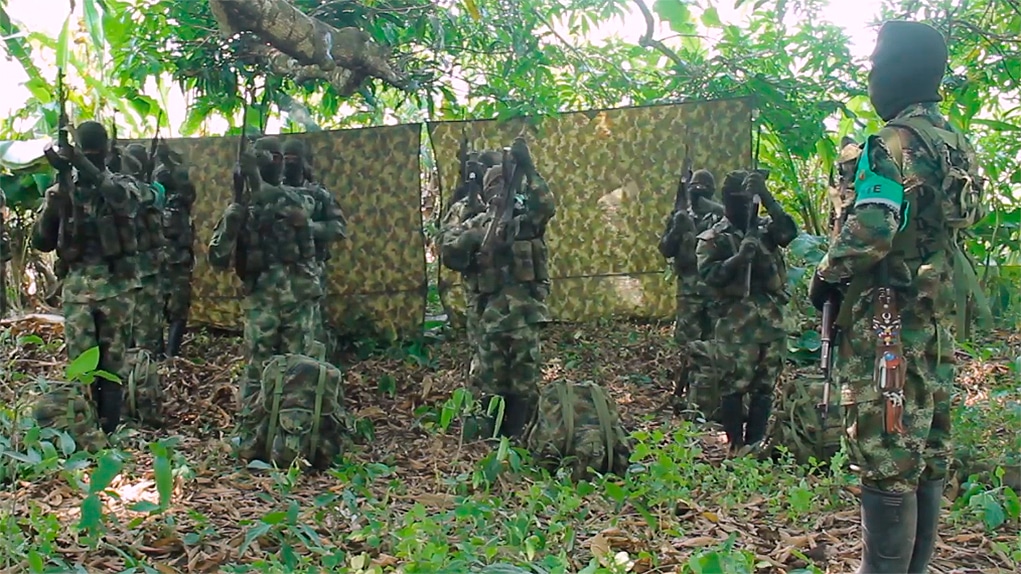
In Llorente, the illegal drug trade is controlled by a group calling itself the Coordinadora Nacional Ejército Bolivariano, a name intended to evoke the political identity of the now-defunct FARC, from which its members claim to be dissidents. Nevertheless, given its origins eight years after the peace agreement with the FARC and the nature of its activities, it is more akin to a criminal organization than a guerrilla group engaged in an armed conflict.
But even if International Humanitarian Law did apply, it does not permit any and all outcomes: it requires a distinction between combatants and civilians, and civilian deaths are permissible only if they are not excessive in relation to the anticipated military advantage and if precautions have been taken to avoid them.
In Colombia, for matters unrelated to the armed conflict, a 2024 decree applies. It states that lethal force may be used only “when there is an imminent threat of death or serious injury, or for the purpose of preventing the commission of a particularly serious crime involving a grave threat to life, or in order to arrest a person who poses such a threat.”
And, at the time of the explosions the Colombian state had suspended offensive operations against the group, with which it was engaged in negotiations. Another theory is that the attacks may have come from a rival armed group, at a time when the use of improvised drones has become common among Colombian armed groups. However, none of the authorities or community sources consulted supports this theory and the absence of explosive remnants is inconsistent with the type of devices used by such groups. The Coordinadora Nacional Ejército Bolivariano, which controls the area, did not attribute the incidents to a local enemy either.
Accounts that emerged during negotiations between the Petro government and Coordinadora delegations indicate that a device emitting a bright light was detected, with a trajectory suggesting it had come “from far away,” in the direction of the Ecuadorian border. VerdadAbierta.com attempted to contact the Coordinadora’s delegates to the negotiating table directly but was unsuccessful.
Residents of Pital de la Costa described seeing what appeared to be a military vessel offshore in the days leading up to the attack, near the Bocana de Pasacaballos, nine kilometers north of the explosion site. According to their accounts, the vessel was in the area on January 22, headed north on January 23, and returned on January 24, the day of the attack.
Airwars, a partner in this journalistic collaboration that investigates, tracks and archives civilian harm and casualties caused by military strikes and air wars in conflict zones, used the Global Fishing Watch satellite-monitoring platform to detect a vessel with its transponder switched off, known as a “dark vessel” near Pasacaballos on the morning of January 24. The blurry satellite image does not make it possible to identify the vessel or its flag. But a small commercial drone such as a DJI Matrice 350 or 400 operated from that location would have had sufficient range to reach the site of the explosion, according to Camilo Mendoza, a retired major in the Colombian Aerospace Force and an expert on drone use.

If bombs did fall on the sites, they do not appear to have been conventional devices. According to a source at the Attorney General’s Office, “no explosive remnants or ballistic material indicating a military-style attack or the use of explosive devices were found at either location.”
In public remarks on March 18, now former Defense Minister Pedro Sánchez said: “Those people were burned to death. Their bodies show no evidence of projectile impacts, nor were any traces of explosives found in the area.”
There was no bomb crater in Pital de la Costa either. Two months after the fire, the ground was still charred, and the trunks of trees more than 50 meters tall surrounding the laboratory had been blackened by the flames. The remains of metal structures lay twisted and melted by the heat.

“What we can see is that there was a very violent deflagration and that it spread rapidly,” said Omar Moreno, an explosives and ordnance-disposal expert, after reviewing photographs of both sites.
The absence of craters and shrapnel does not necessarily contradict the theories that there was an attack. It is “not far-fetched” to think the fires may have been caused by an incendiary device, Moreno said. Combined with an atmosphere saturated with invisible vapors from the chemicals used in the laboratories, inside enclosed spaces such as these processing sites, such a device could cause fires like those in Inda Sabaleta and Pital de la Costa.
Moreno says the evidence needed to establish this would be found in soil samples, the location of any drone debris and the presence of the container that held the incendiary substance. The source at the Attorney General’s Office said they are still awaiting the results of tests on chemical compounds found in samples collected at the two sites.
But for some survivors of the attacks, there is no doubt: “What happened here was an incendiary bomb. Nobody can convince me otherwise,” says a member of the Pital de la Costa community.
The Hypotheses
Three people close to Colombia’s previous government, who requested anonymity because they were not authorized to discuss the matter, said former president Gustavo Petro was convinced that what happened had been launched from Ecuador using drones with U.S. intelligence support. However, he never presented evidence.
If that information were corroborated, “Petro would have been under immense pressure from the left to do something,” says a diplomatic source who requested anonymity. Given Petro’s precarious position vis-à-vis the United States at the time, “it would have gone against his own interests” for the information to be publicly confirmed, the source adds.
VerdadAbierta.com requested an interview with former president Petro to ask what evidence those assertions were based on and whether his government ever received official information about the origin of the attacks. There was no response.
At the time of the explosions, Petro was preparing to meet with Donald Trump on February 3, 2026, after a year of tensions that had begun just days after the U.S. president was inaugurated for his second term.
The standoff escalated month by month. It went from threats of tariffs and the revocation of visas for some officials to Washington’s “decertification” of Colombia because, according to the United States, its government had not done enough to combat drug trafficking. In October 2025, Petro was added to the OFAC financial sanctions list for his alleged “involvement in the global illicit drug trade,” despite there being no evidence to that effect.
The meeting between Petro and Trump eased tensions in the bilateral relationship. According to several sources familiar with their conversation, the attacks in Nariño were not discussed, but Petro alluded to them at the subsequent press conference. “In recent days, we have seized nearly 15 tons of cocaine without any deaths. But on the border with Ecuador, there are dozens of people burned to death,” he said. “These are two different methods, two very different ways of understanding the fight against drug trafficking.” On another occasion, he urged coca growers to replace their crops “before we are burned alive by drones.”
Relations with Ecuador, by contrast, deteriorated sharply. In January 2026, President Daniel Noboa—a staunch Trump ally—unexpectedly imposed tariffs on Colombian products, citing a lack of cooperation in combating drug trafficking along the border.
Just three days after the explosion in Llorente and one day after the one in Pital, U.S. Under Secretary of War Joseph Humire visited Ecuador. Henry Delgado, head of the Joint Command of the Ecuadorian Armed Forces, said the meeting was intended “mainly to find ways to improve security along the northern border.”
Ecuador has categorically denied operating on Colombian territory, following the discovery in March of an unexploded Ecuadorian-made bomb on the Colombian side of the border. A binational commission determined that the device had probably struck Ecuadorian territory and, after ricocheting, landed on the Colombian side.
The U.S. military’s Southern Command did not respond to specific questions about whether ground attacks had been carried out as part of Operation Southern Spear or whether intelligence on cocaine laboratories in Colombia had been shared with Ecuador.
“For operational security and force protection reasons, we do not discuss intelligence or details about our operational processes and planning,” a spokesperson said in a written response.
In the run-up to the U.S. operation to capture then-Venezuelan leader Nicolás Maduro on January 3, 2026, CNN reported that the CIA had carried out a drone strike against a dock allegedly used to load drugs.
Few Certainties, Many Coincidences
Recent reports by The New York Times and The Washington Post indicate that covert operations may have been behind the disappearance of a fishing boat near the Galápagos Islands on January 20, two days before the attack in Inda Sabaleta.
According to the Post, it was a “covert action”: an operation authorized by the president of the United States in which Washington does not publicly acknowledge its role. No government has claimed responsibility for what happened.
That stands in contrast to the celebratory posts that the U.S. military’s Southern Command has published since September 2025 following each of the strikes on 69 vessels allegedly carrying drugs in the Caribbean and Pacific, which have killed 227 people. This journalistic alliance investigated the issue and in May published The Bombed: No Right to Defense.
The fishing boat Fiorella disappeared near the Galápagos Islands carrying eight crew members who are presumed dead, as they have still not been found. In March, two other vessels, the Don Maca and the Negra Francisca Duarte II, were attacked; their crews survived. No public evidence has emerged that any of these fishermen were involved in drug trafficking.
However, the pattern described by survivors of the attacks on the Ecuadorian boats is almost identical to the accounts given by workers in Pital de la Costa and Inda Sabaleta. Before each attack, the crews saw drones and an aircraft circling for days. Then, according to survivor testimony collected in a Human Rights Watch report, small drones dropped devices onto the vessels, engulfing them in flames.
Nothing in the Times or Post investigations mentions the laboratories in Nariño. But the timing and the method coincide: prior surveillance by drones, followed by fire for which no one has claimed responsibility.
Invisible Victims
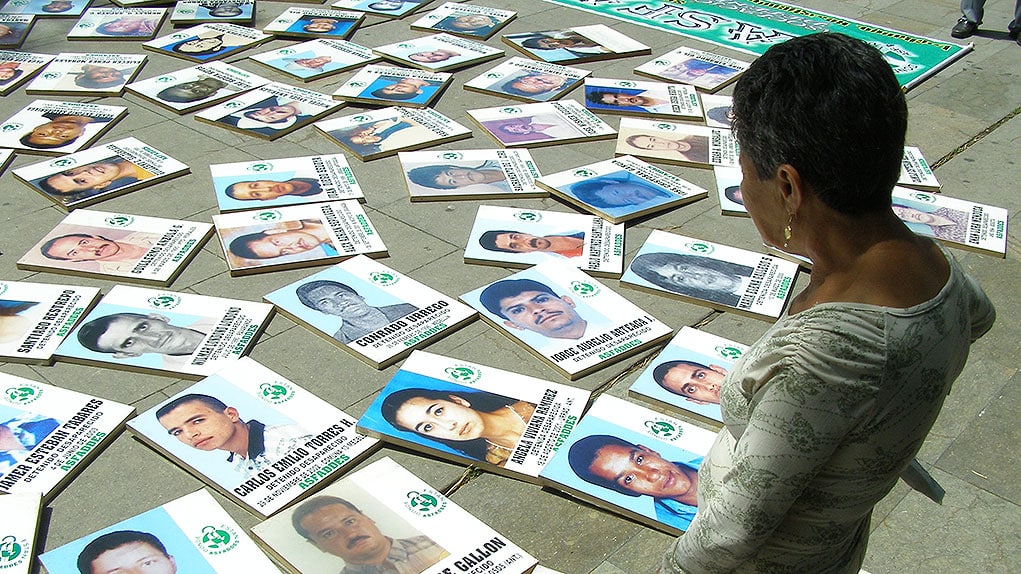
The official data from the National Institute of Legal Medicine and Forensic Sciences accounts for 14 lethal victims in the two explosions: 12 in Inda Sabaleta and two in Pital de la Costa. Those who made it out alive, however, say the death toll was higher.
Wilmer, the survivor of the Inda Sabaleta laboratory, says that only the civilian dead and injured were taken to the morgue and hospitals. According to him, another 20 people—members of the armed group—also died in the blaze but were buried clandestinely. VerdadAbierta.com was unable to corroborate that figure, although it is consistent with Petro’s statements about “dozens burned to death.”
A forensic report records the arrival at the Tumaco morgue of 12 bodies from Inda Sabaleta. “Of these, five bodies were charred and three had burns covering 90 percent of their body surface,” according to the report.
Because of the condition in which the remains were found, they had to be identified through DNA testing.
“We kept asking to identify him, but they said we couldn’t because he was too badly burned. They gave him back to us 21 days later,” says Matías’s mother, Milena Valencia.
The official death toll from the Pital de la Costa explosion also differs from witness accounts.
Forensic records include the deaths of José Manuel Caicedo Guerrero, known as “La Máquina,” and Carlos Arturo “Popeye” Segura, because both were evacuated from the village to hospitals in Tumaco and Pasto, where they later died.
The deaths of brothers Andrés and Edin Poniel Coime Angulo and César Antonio González were recorded only in the memories of their relatives and neighbors in Pital de la Costa and in the burial vaults of the town’s small cemetery. The morgue has no record of them.

For residents of rural Nariño, working in cocaine laboratories is not born of a criminal vocation but is instead a survival strategy in a region where there are few other ways to make a living.
“It’s the only source of employment that really keeps these communities going. I know it’s illegal, but it’s what there is,” explains Duván Caicedo, a community leader in Pital de la Costa. “How are you supposed to build a home when there are no jobs?”
Despite the illegality of the activities, international law permits the use of lethal force only when it is strictly unavoidable in order to protect life from an imminent threat. In a legal analysis of the U.S. campaign of strikes against alleged drug-smuggling boats, Ben Saul, the United Nations Special Rapporteur on the promotion and protection of human rights while countering terrorism, concludes that the attacks amount to “serial extrajudicial executions,” rejecting Washington’s argument that it is engaged in a “war against narcoterrorists.”
“Even assuming that the targeted vessels and crews were members of the criminal groups designated as terrorists, such organizations have not launched any ‘armed attack’ against the United States that would trigger the right of self-defense,” Saul wrote.
The United States, however, takes a different view. On December 1, 2025, White House Press Secretary Karoline Leavitt, responding to a question about the strikes on the boats, said: “President Trump and Secretary (of War Pete) Hegseth have made it clear that presidentially designated narcoterrorist groups are subject to lethal targeting in accordance with the laws of war.”
At the time of the incidents in Tumaco, the Coordinadora Nacional Ejército Bolivariano had not specifically been designated by Trump as a narcoterrorist group, but the Segunda Marquetalia, from which it split, has been on the list since 2021.
The chongo workers thought they knew the dangers of their jobs: a drug seizure, a military operation that destroyed the laboratory, an accident involving the hazardous chemicals used to make cocaine. What they did not anticipate was that death would come from the sky in the darkness. “We call it a massacre,” Caicedo says. “We would like to see justice done. A real investigation that establishes what happened.”
“Whether it was the Colombian state, the Ecuadorian state or the United States, the only difference is whom the claim should be brought against,” says Ramírez, the international law analyst.
But political winds have shifted in Colombia, and the possibility of pursuing such a claim now appears remote. On August 7, right-wing lawyer Abelardo de la Espriella assumed the presidency, bringing with him a 180-degree shift in policy. He ended his predecessor’s controversial “Total Peace” policy of seeking negotiated settlements and pledged to intensify airstrikes against armed groups, and announced the resumption of aerial spraying of coca crops. And unlike Petro, he has made the alliance with Washington the cornerstone of his security policy.

According to Hegseth, that alliance would include combined operations involving U.S. troops on Colombian territory under the recently created Joint Task Force Western Hemisphere. Following a September 8 meeting with Secretary of State Marco Rubio, De la Espriella declared that Colombia would become the United States’ principal partner in combating drug trafficking in South America. “We are going to start spraying; we are going after the laboratories, the precursor chemicals, the routes and the drug-trafficking kingpins,” he said.
He also confirmed that Medellín, Colombia’s second-largest city, will serve as the headquarters of Shield of the Americas, a U.S.-led multinational coalition against organized crime and drug trafficking.
Meanwhile, in Pital de la Costa, residents are still waiting for answers. No judicial authority has returned to the village since the Attorney General’s CTI investigators visited in January. And drones continue to circle in the skies over Tumaco.
*Names have been changed to protect the interviewees.
Bombed: No Right to Defense is an investigation into the civilian victims of U.S. attacks in Latin America, coordinated by the Latin American Center for Investigative Journalism (CLIP) in partnership with Casa Macondo, Verdad Abierta and 360 Grados (Colombia); Runrunes, Tal Cual and El Pitazo, members of the Alianza Rebelde Investiga (Venezuela); the Trinidad and Tobago Guardian (Trinidad and Tobago); and with technical support from Airwars (United Kingdom) and El Veinte.
Relacionados